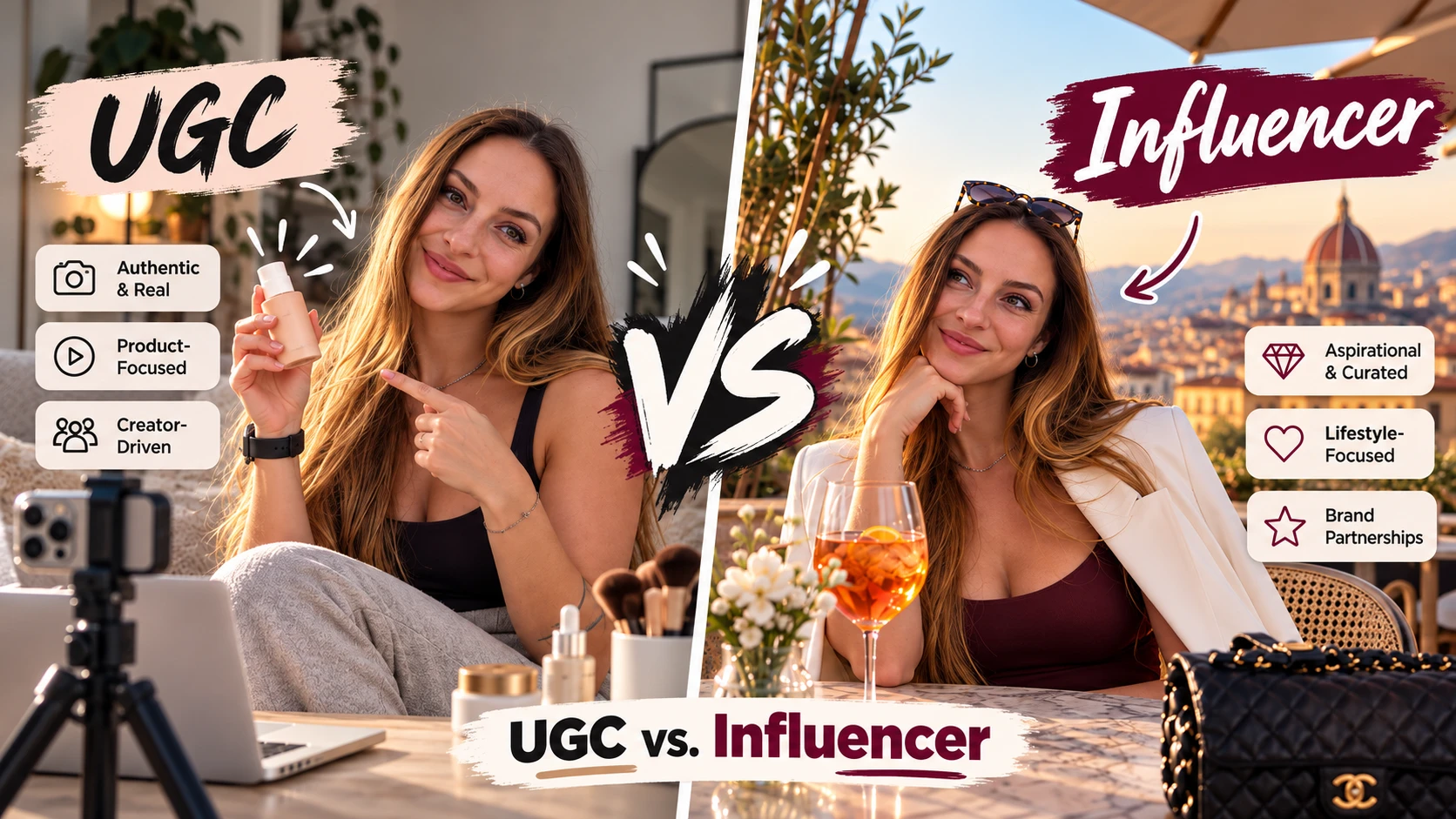
The biggest reach doesn't automatically win the best campaign. In influencer marketing in 2026, what increasingly counts is creator fit, storytelling and the ability to scale content in a targeted way through paid advertising.
For brands, this changes how influencers are selected, how campaigns are planned and how budgets are spent.
While organic reach used to be the main focus, creators today are increasingly also producers of advertising content. With Meta Partnership Ads and TikTok Spark Ads, brands can deploy authorized creator posts as targeted ads.
This doesn't just change the role of influencers. It also changes how companies think about content, usage rights, compensation and performance.
At Not Nice, we see this shift first-hand: in around 70% of our influencer campaigns, we work with creators who have fewer than 30,000 followers. At the same time, based on our operational experience, about eight out of ten of the brands we support use Partnership Ads or Spark Ads.
What's behind this development? And why can a compelling script achieve more than an elaborate video production?
Key Takeaways
- Micro-influencers are becoming more relevant for many brands because they bring specific communities and different creative perspectives.
- Creator content is increasingly not only published organically, but also used in paid social campaigns.
- Meta Partnership Ads and TikTok Spark Ads combine authorized creator content with paid distribution.
- Good storytelling, creator fit and creative testing can matter more for campaign performance than pure reach or production aesthetics.
- Professional creator work should be paid fairly. That's why Not Nice relies on financial payouts for commissioned creator campaigns.
- Successful creator strategies combine content, community, different hooks and data-driven media buying.
1. What Are Micro-Influencers?
Micro-influencers are content creators with a comparatively small, often topic-focused community.
A common guideline is between 10,000 and 100,000 followers. However, there is no universally binding definition.
At Not Nice, for many campaigns we focus in particular on creators with fewer than 30,000 followers. Depending on the definition, this can also include nano-influencers.
Why? Because we don't judge influencers solely by their follower count.
Other factors are decisive for a successful campaign:
- How well does the creator fit the brand?
- Which audience do they reach?
- How credibly can they present a product?
- What creative skills do they bring?
- How suitable is their content for paid advertising?
- Which usage rights are available?
Reach remains relevant. But it's only one part of the decision.
70% of Our Influencer Campaigns Rely on Creators With Fewer Than 30,000 Followers
Based on our internal campaign experience, we work with creators who have fewer than 30,000 followers in around 70% of our influencer campaigns.
This is a deliberate choice.
Working with smaller creators allows us to take different content styles, communities and creative perspectives into account.
Instead of relying solely on one person with a large reach, brands can use several well-matched creators to test different audiences and communication approaches.
That doesn't mean macro-influencers generally perform worse. For large awareness campaigns, high-reach personalities can still make sense.
But the key question is no longer only: How many people does this influencer reach?
Increasingly, it's: What can we achieve with their content, their credibility and our marketing strategy?
Source: Not Nice, internal operational campaign experience. This figure is not a representative market statistic.
2. Influencer Marketing Is Changing: From Organic Post to Advertising Asset
For a long time, classic influencer campaigns were strongly focused on organic reach.
A brand hired an influencer, the influencer published a post, and the collaboration was evaluated, for example, based on views, reach and engagement.
This model still exists.
Today, however, influencer content can also be integrated into paid advertising campaigns. As a result, the economic value of a creator collaboration can extend beyond the original publication.
A video can first reach an influencer's existing community and then, with the appropriate authorization, also be distributed through paid media.
92% of Surveyed Marketing Leaders Use Creator Content in Paid Media
How closely creator marketing and paid advertising are already connected is shown by CreatorIQ's Creator-Powered Funnel Report 2026.
According to the study:
- 92% of the surveyed paid media and marketing leaders use creator content in paid advertising,
- creator content makes up an average of 44% of their paid media creatives,
- 77% of respondents say that creator content performs better than traditional brand creatives in their campaigns.
For the report, a total of 100 marketing leaders from the US and the UK were surveyed in May 2026.
The results show a clear trend within this sample. However, they cannot be applied without qualification to the entire international market.
Source: CreatorIQ – Creator-Powered Funnel Report, 10 June 2026
The trend matches our experience at Not Nice: creator marketing is evolving from an isolated reach discipline into a component of comprehensive content and performance strategies.
3. Partnership Ads and Spark Ads: Why Using Creator Content for Advertising Is Becoming More Important
A central part of modern influencer campaigns is the ability to use creator content as advertising. Meta and TikTok provide dedicated formats for this.
What Are Meta Partnership Ads?
Meta Partnership Ads allow brands to collaborate with creators and other partners and to use content or identities approved for this purpose in advertising campaigns.
The specific permissions required depend on the respective ad format and the technical setup.
What Are TikTok Spark Ads?
TikTok Spark Ads make it possible to use organic TikTok posts for paid advertising.
A creator can, for example, approve a post via an authorization code. The brand can then use it in an advertising campaign within the scope of the permission granted.
That's why, in these collaborations, it's not only the compensation for creating or publishing a post that matters, but also the agreed advertising usage.
Source: TikTok for Business – Spark Ads Creation Guide
In Our Experience, Eight Out of Ten Brands We Support Use Creator Ads
At Not Nice, we observe that roughly eight out of ten of the brands we support include Partnership Ads or Spark Ads in their creator marketing activities.
For us, this is a clear signal: the discussion about influencer marketing can't stop at follower counts.
Brands should clarify early on whether a piece of creator content will be published only organically or also used as an advertising asset.
This makes the following all the more important:
- choosing the right creator
- suitable content formats
- advertising usage rights
- technical approvals
- creative testing
- media buying and campaign evaluation
Source: Not Nice, internal operational experience with the brands we support. This figure is not a representative industry statistic.
4. Why the Swiss Influencer Market Poses Particular Challenges
In Switzerland in particular, we're seeing an interesting development.
The market is comparatively small. At the same time, the choice of suitable creators in certain languages, regions and niches is limited.
For a brand that wants to reach a specific Swiss community, for example, only a few suitable influencers may be available.
When several companies want to work with the same creators at the same time, this demand can affect their compensation expectations.
In our experience, the fees asked by in-demand Swiss niche creators have in some cases risen significantly in recent years. This applies not only to comprehensive buyouts, but also to collaborations with additional advertising usage rights.
Higher Creator Fees Change the Economics
A higher creator price isn't automatically a problem. A campaign can be profitable even with higher production and licensing costs.
What matters is whether the overall marketing strategy works. For brands, this means not looking at the creator fee in isolation.
Relevant factors include:
- creator compensation
- content production
- usage rights
- media budget
- campaign management
- conversion rate
- customer acquisition costs
- return on ad spend
A collaboration with a popular creator doesn't guarantee a positive ROAS.
When costs rise, realistic budget planning, suitable creatives and professional media buying become even more important.
5. The Creative Game Is Changing: One Product, Multiple Hooks
Another shift concerns how influencer content is conceived.
Instead of producing a single video with a fixed opening, brands can test different hooks and storytelling approaches.
A hook is the opening of a video. It's meant to grab attention and give the audience a reason to keep watching.
Different creative approaches can work for one and the same product.
Example: Three Hooks for One Product
Hook 1 – Problem-focused “You know that feeling when you buy a product and only realize later what you should have been paying attention to?”
Hook 2 – Personal experience “I've added this product to my daily routine. Here's what I noticed.”
Hook 3 – Product-focused “Three features you should compare before buying this product.”
All three approaches potentially convey different information and appeal to different interests.
Which variant works better depends on the audience, the product and the campaign context. That's why we recommend testing different hooks and creative angles instead of relying solely on a single version.
A good brief should leave room for the creator's personality. Authentic personal statements must be based on actual experience. Product and efficacy claims must be verifiable.
6. Why Storytelling Can Matter More Than Production Quality
A high-end camera setup doesn't guarantee compelling advertising content.
Professional video production continues to play an important role – especially for image films, brand campaigns and high-end product staging.
With performance-oriented creator content, however, a different question can be decisive: Does the story address the needs of the right audience?
An aesthetically perfect video can be visually impressive without addressing a relevant purchase motive. A simply filmed creator video, on the other hand, can tell an understandable, personal and credible story.
Our experience shows that the creative approach can be at least as important for performance as the technical execution.
Case Study: A Supplement Campaign With Four Times the ROAS
In a campaign for a supplement brand, we compared different content approaches.
On the one hand, visually high-quality, aesthetically produced content was used. On the other, conventional UGC videos were created with various storytelling approaches and creative angles.
The execution took creator fit, the product and the seasonal context into account.
The result: The storytelling campaign achieved a ROAS four times as high as the average ROAS of the campaign under review.
This result reinforced our conviction that production aesthetics alone don't determine a campaign's success.
However, this is a single example from practice and not a controlled scientific test. Differences in creators, seasonality, audiences, distribution and other factors may have influenced the result. It therefore cannot be concluded that storytelling generally performs four times better than aesthetic content.
What we take away from the campaign: More production effort doesn't automatically mean more revenue. A relevant story can be decisive for performance.
Source: Not Nice, anonymized internal campaign example. The results cannot be transferred to other campaigns.
7. Barter Deals vs. Paid Creator Campaigns: Why Fair Compensation Matters
The compensation model is another part of the shift in creator marketing.
Companies still work with barter collaborations. In these, creators receive, for example, a product in exchange for an agreed service.
In principle, such collaborations can make sense – especially for small, voluntary collaborations or products of corresponding value.
However, it's important to distinguish between non-binding PR seeding and a concrete production assignment.
With non-binding seeding, creators receive products without being obligated to publish anything. With a commissioned content project, on the other hand, there are clear expectations. These can include:
- a detailed brief
- a predefined script
- multiple video takes
- different hooks
- revision rounds
- fixed deadlines
- additional usage rights
That's creative work.
Why Not Nice Pays Creators
At Not Nice, we take a clear stance: if you expect professional creator work, you should plan a real budget for it.
That's why our commissioned creator campaigns include a financial payout.
Especially for products with a low or medium retail value, we don't consider it appropriate to compensate extensive production requirements solely with free products.
This isn't only about fairness. Clear compensation makes it easier to set out the scope of work, expectations and rights professionally.
Through Not Nice's multi-bidding system, creators can submit their own price proposals. Brands can evaluate the offers based on their campaign requirements.
Financial compensation doesn't, of course, guarantee a high-quality creative. But it creates a professional foundation for the collaboration.
Our approach is therefore: Better Creator Partnerships. Better Stories.
8. A Good Creator With a Bad Script Is Still a Weak Creative
When selecting creators, many brands focus heavily on follower counts, engagement or visual quality. These factors are relevant.
But no matter how professional a creator comes across – if the message doesn't resonate with the audience, it won't automatically become a successful ad.
Conversely, a less experienced creator with a compelling story and a well-thought-out script can achieve strong results.
That's why at Not Nice we don't rely solely on creator selection. We look at the interplay of:
Creator Fit + Creative Strategy + Storytelling + Distribution
What Makes a Good Creator Script?
- A clearly defined problem: Which situation or need of the audience is being addressed?
- A relevant creative angle: From what perspective should the product be presented?
- A compelling opening: Why shouldn't a user scroll past the video right away?
- A credible product integration: How can the product be naturally woven into the creator's story?
- A fitting call to action: What should the audience do after watching the video?
- Room for iteration: Which hooks, edit variants and storytelling approaches can be tested afterwards?
The creative shouldn't be seen as a one-off production, but as part of a continuous learning process.
9. Why Creator Marketing and Performance Marketing Belong Together
Integrating creator content into different marketing channels is a central topic internationally as well.
In the State of Creator Marketing 2026–2027 report, CreatorIQ, together with Sapio Research, examined the development of creator marketing based on a survey of 2,000 brand and agency representatives in nine countries.
Among other things, the report describes the growing importance of technology, integrated workflows, performance measurement and the cross-channel use of creator content.
Source: CreatorIQ – State of Creator Marketing 2026–2027, 30 September 2026
For us, this development confirms an important strategic approach: creator marketing shouldn't be viewed in isolation from the rest of marketing. Instead, brands can build a repeatable process.
- Find the right creators: Selection is based not only on reach, but also on audience, content style, language, brand fit and campaign goal.
- Develop different stories: Various hooks and creative angles are worked out for one product.
- Brief and pay creators professionally: Deliverables, usage rights, deadlines and expectations are defined before production.
- Combine organic and paid distribution: Suitable creator posts can also be used in paid social campaigns with the necessary approvals.
- Evaluate creatives: Depending on the campaign goal, metrics such as click-through rate, conversion rate, CPA, ROAS and others are taken into account.
- Develop successful approaches further: Based on the results, new variants, hooks or creator combinations are tested.
This creates a continuous process instead of a series of isolated one-off campaigns.
10. How Not Nice Scales Creator Marketing
Not Nice combines technology, creator matching and campaign management with additional services in strategy and production.
Brands can organize campaigns themselves or use additional support from the Not Nice team.
The platform offers, among other things:
- data-driven creator selection
- multi-bidding and individual creator compensation
- digital campaign management
- tools for briefings and scripting
- UGC and influencer campaigns
- optional done-for-you production
- support with content for different marketing channels
Not Nice is active in DACH, the Balkans and the Middle East.
The approach goes beyond creating individual UGC videos. Depending on the project, creator content, influencer marketing, professional video production and performance marketing can be combined.
Our goal is to help brands not just produce content, but build repeatable and scalable marketing processes.
Because a successful creator campaign isn't created in front of the camera alone. It comes from the interplay of well-matched creators, relevant stories and a well-thought-out marketing strategy.
Conclusion: The Future Doesn't Automatically Belong to the Biggest Influencer
Micro-influencers are becoming an important part of many brands' marketing strategy – not solely because of their follower counts, but because of their specific audiences, their different creative perspectives and the opportunities to use their content in paid campaigns.
At the same time, the market continues to evolve. In Switzerland in particular, we're seeing high demand for suitable niche creators and, in some cases, rising compensation expectations.
This makes it all the more important to plan campaigns strategically and not to view creator content solely as a one-off social media post.
Our experience from various campaigns shows how relevant the combination of creator fit, storytelling, testing and media buying can be.
The key insight: A big creator with a weak script isn't automatically a good investment. A smaller creator with the right story, on the other hand, can become a valuable performance asset.
The future of influencer marketing therefore doesn't lie solely in greater reach. It lies in intelligently connecting creators, content and distribution.
Ready to scale with creators?
Do you want to combine micro-influencers, UGC and paid social strategically?
With Not Nice, you can find the right creators, organize campaigns through one central platform and, if needed, have your content production fully managed for you.
Frequently Asked Questions About Micro-Influencer Marketing
What is a micro-influencer?
A micro-influencer is a content creator with a comparatively small community. The range of 10,000 to 100,000 followers is commonly used. The exact definition can vary by provider and market.
Why do brands rely on micro-influencers?
Micro-influencers can reach specific communities and produce content with different creative perspectives. For companies, audience fit, credibility and content quality are particularly relevant alongside reach.
What is the difference between UGC and micro-influencer marketing?
With UGC, the focus is primarily on producing content. With influencer marketing, publishing through a creator's channels and reaching their community also matter. One person can take on both roles.
What are Meta Partnership Ads?
Meta Partnership Ads are ad formats in which brands, subject to the relevant requirements, can collaborate with creators and other partners and use content or identities approved for this purpose in advertising.
What are TikTok Spark Ads?
TikTok Spark Ads make it possible to use authorized organic TikTok posts as paid advertising. Creators can approve such use via an authorization code, among other options.
Are micro-influencers cheaper than macro-influencers?
Not necessarily. Prices depend on factors such as the audience, demand, scope of work and usage rights. In small markets like Switzerland in particular, in-demand niche creators can have high compensation expectations.
Do barter collaborations still make sense?
Barter collaborations can make sense depending on the product and the agreement. For professional content assignments with binding production requirements, Not Nice recommends financial compensation.
What's more important: creator fit or storytelling?
Both factors are important. A well-matched creator can represent a brand credibly. Good storytelling helps convey the right message and relevant purchase motives.
How do you measure the success of creator ads?
Depending on the goal, metrics such as reach, engagement, click-through rate, conversion rate, customer acquisition costs and ROAS are suitable. For a reliable comparison, ad budget, attribution, campaign period and audience should also be taken into account.
Sources and Methodology
Editorial status: 8 October 2026
External Sources
- CreatorIQ – Creator-Powered Funnel Report (2026). Published on 10 June 2026. Survey of 100 marketing leaders from the US and the UK on creator content, paid media and campaign performance. creatoriq.com
- CreatorIQ – State of Creator Marketing 2026–2027. Published on 30 September 2026. International survey of 2,000 brand and agency representatives from nine countries on the development of creator marketing. creatoriq.com
- TikTok for Business – Spark Ads Creation Guide. Official technical documentation on creating Spark Ads and authorizing creator content. As of: June 2026. ads.tiktok.com
Not Nice Internal Insights
The figures on around 70% of influencer campaigns with creators under 30,000 followers and on eight out of ten supported brands using Partnership Ads or Spark Ads are based on Not Nice's internal operational experience.
The supplement campaign described, and the fourfold average ROAS achieved there, also come from an internal campaign example.
No sample sizes or specific evaluation periods are published for these figures in this article. The values should therefore be understood as company-specific experience and not as representative market statistics.
The results of individual campaigns depend on various factors. These include product, audience, creator fit, creative, seasonality, media budget and campaign management, among others.
The results described are no guarantee for future campaigns.
This article is intended for professional information and reflects Not Nice's editorial assessment based on the sources and experience cited.