UGC or influencer marketing? If you want to scale with creator content in 2027, you may be asking the wrong question. The future lies not in choosing between the two approaches, but in combining them intelligently.
While classic influencer campaigns were long focused on reach, brands are increasingly relying on an interplay of UGC, influencers, organic content and paid advertising.
At Not Nice, we see this shift every day. What matters is no longer only how many people a creator reaches. It also matters which story they tell, which audience they speak to and how the content they produce can be reused.
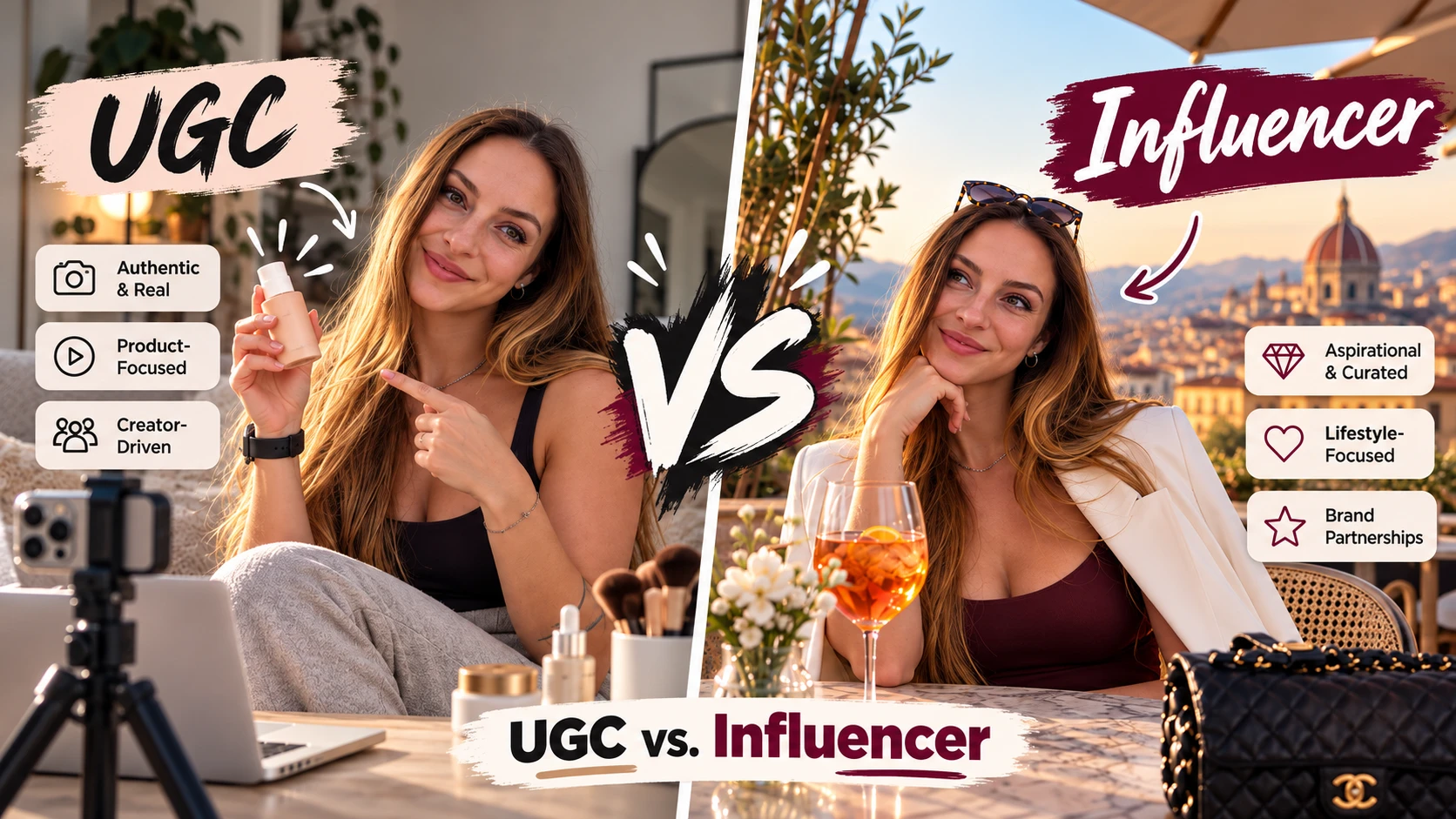
UGC vs. Influencer Marketing: What Is the Difference?
In professional creator marketing, UGC (user-generated content) focuses primarily on producing content. The brand can then use it, for example, on its own social media channels or in ads, provided the corresponding usage rights have been agreed.
Influencer marketing adds the creator's reach. The content is published on the creator's own channels and reaches their community.
| UGC Marketing | Influencer Marketing |
|---|---|
| Focus on content production | Focus on content and community |
| Follower count is not decisive | Reach and audience play a role |
| Used on brand channels and in ads | Published on creator channels |
| Compensation for the content work | Compensation for content, publication and, where applicable, advertising rights |
The boundaries are increasingly blurring. Today, a micro-influencer can produce content, publish it organically and, with the appropriate authorisation, make it available for paid advertising.
So why develop two separate strategies when both approaches can be combined in a meaningful way?
Creative Diversity: Why a Single Ad Video Is Not Enough
Creative variety is an important factor in modern creator campaigns.
A brand can have the same product presented by different creators and from different perspectives.
A food creator tells a different story than a fitness creator. A lifestyle creator, in turn, places the product in an entirely different context.
This creates different creative angles that can appeal to different needs and interests.
This development is also relevant to the technical systems of advertising platforms.
With Meta Andromeda, introduced in December 2024, Meta relies on AI-powered methods to select relevant ads. The technical development also takes into account the growing number and variety of ad creatives.
Source: Meta Engineering – Meta Andromeda
This does not mean that more videos automatically deliver better results.
What matters is that the creative approaches genuinely differ and that their impact is tested against campaign data.
Ten similar videos are not a creative diversity strategy. Ten different stories, on the other hand, can deliver valuable insights.
Why the Mix of UGC, Influencers and Paid Ads Matters
For many brands, the challenge is to combine organic visibility with paid reach.
UGC can provide different creative perspectives. Influencers additionally bring their community and personal credibility.
With Meta Partnership Ads and TikTok Spark Ads, suitable, authorised creator content can then also be distributed through paid advertising.
TikTok explicitly describes Spark Ads as a format that allows organic creator posts to be used as ads once they have been authorised accordingly.
Source: TikTok for Business – About Spark Ads
Organic content also remains important. It can contribute to a brand's presence over the long term and reach people who research products on social media platforms.
For a sustainable creator strategy, brands should therefore not simply book individual influencers or produce isolated ad videos.
They should consider how content, community and distribution work together.
From Love Brand to Community Brand
The FMCG sector in particular shows how important recurring brand presence is.
From our work with brands such as Migros, NOCCO Switzerland and Vitamin Well Switzerland, we know that different content formats, creators and marketing channels can each fulfil their own role.
A creator video can introduce a product. An influencer campaign can reach new people. An activation in retail creates an additional touchpoint.
The challenge lies in connecting these measures in a meaningful way.
Strong brands should not just be visible. They should be present in a relevant way for different audiences.
This requires creativity, continuous production and a willingness to try out new creators and content approaches.
How Would Not Nice Plan a CHF 10,000 Creator Campaign?
Let's take an FMCG brand that is already available in Swiss retail and wants to increase its awareness.
One possible starting point would be the following budget split:
| Area | Budget |
|---|---|
| UGC and creative production | CHF 4,000 |
| Influencer collaborations | CHF 3,000 |
| Paid media | CHF 3,000 |
| Total | CHF 10,000 |
This model is an illustrative planning example from Not Nice, not a fixed rate and not a universal budget recommendation.
The goal would be to develop different stories with various creators, use selected influencers for organic publications and test suitable content through paid advertising.
How many creators and assets are actually used depends on fees, usage rights and the scope of production.
We cover the detailed planning – from creator selection and creative testing to budget management – in our upcoming Creator Scaling Guide 2027.
Conclusion: The Right Mix Wins
UGC and influencer marketing are not opposites.
For brands that want to scale in 2027, the opportunity lies in combining them.
What matters is not booking as many creators as possible or publishing as many videos as possible.
It is about choosing the right people, developing different stories and deploying content through the right channels.
At Not Nice, we bring together creator matching, multi-bidding, campaign management and professional content production on one platform.
Don't scale creators. Scale what works.
Coming Soon: The Creator Scaling Guide 2027
How many creators does a brand really need? Which creative angles should it test? How do you split content and media budgets? And how do individual campaigns become a scalable creator marketing system?
In the upcoming Not Nice Creator Scaling Guide 2027, we present our framework for creator selection, content production, creative testing and paid distribution – with concrete budget models and experience from our work with brands.
Until then: Discover the Not Nice platform.
Frequently Asked Questions
Is UGC better than influencer marketing?
Not in principle. UGC is particularly well suited to producing content, while influencer marketing can additionally bring organic reach and community. Both approaches can be combined.
Why is creative diversity important for Meta Ads?
Different creatives can address different audience needs and purchase motivations. Their effectiveness should be verified through structured testing. More content alone does not guarantee better campaign results.
What are Spark Ads?
Spark Ads are TikTok ads in which organic posts can be used for paid advertising with the appropriate authorisation.
How much budget should a brand plan for creator marketing?
That depends on the goal, market, scope of production and advertising strategy. In this article, Not Nice shows one possible budget split for a CHF 10,000 FMCG campaign.
Sources and Transparency
Editorial status: 8 October 2026
This article is based on publicly available technical information as well as the operational experience and strategic assessments of Not Nice.
External sources:
- Meta Engineering – Meta Andromeda, 2 December 2024
- TikTok for Business – About Spark Ads, as of June 2026
The budget split and the assessments of creator strategy represent Not Nice's own editorial recommendations. They are not universally valid industry standards.
Marketing results depend on factors including audience, product, creator selection, creative, seasonality and media buying. The approaches described do not guarantee any particular campaign results.