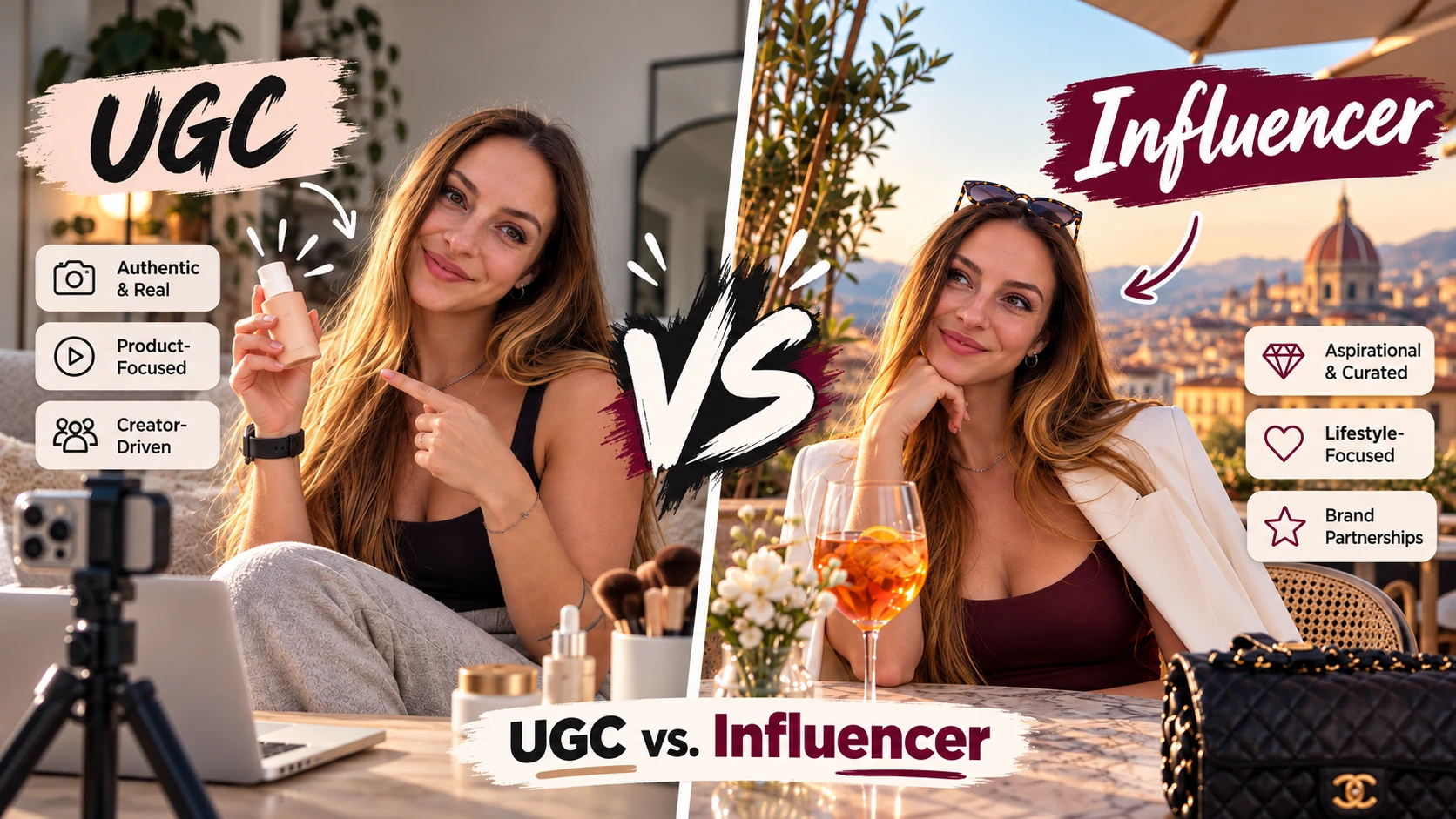

UGC and creator content do not replace professional advertising. They solve a different problem. Professional productions maximise control, visual language and brand staging. Creator content, on the other hand, allows brands to test different people, hooks, messages and formats against each other more quickly. In performance marketing in particular, this speed of iteration can be a decisive advantage for scaling.
So the most important question is not:
Is UGC better than professional advertising?
But rather:
What kind of content do we need for which goal?
Key Takeaways
Creator content and professional advertising have different strengths. Creator content is particularly well suited to variation, testing and fast iteration. Professional productions, in turn, offer more control over staging and brand image.
UGC is not automatically more authentic or more successful. A badly scripted creator video is still a bad creative.
Creative diversity is a key lever in performance marketing. Different creators, hooks, messages and formats help brands test different communication hypotheses.
Professional advertising can also be produced at scale. A well-planned production day can deliver numerous hooks, cutdowns and formats.
The biggest advantage of creator content therefore does not automatically lie in its price. It often lies in the speed at which new creative hypotheses can be produced and tested.
The strongest content systems combine both approaches: creator content for testing and performance, professional production where staging and brand building are decisive.
1. What Does UGC Actually Mean?
UGC stands for user-generated content.
Strictly speaking, user-generated content refers to content that a brand's users or customers create on their own initiative, without a direct production brief from the brand.
This can include reviews, unboxings, posts, videos or photos from customers.
In today's social media marketing, however, the term "UGC" is often used more broadly.
Brands and agencies frequently also speak of UGC when a creator is specifically paid to produce content that looks like organic user content.
At Not Nice, we therefore draw a professional distinction between:
Genuine user-generated content
Content created by customers or users without a direct production brief from the brand.
Creator content or UGC-style content
Content that a brand commissions from a creator on purpose and that deliberately adopts the language and aesthetics of organic social media content.
For performance marketing, we therefore usually speak more precisely of creator content.
A large follower count is not essential for this. The creator can be used primarily as a content producer. Distribution then takes place, for example, via the brand's own channels or through paid social.
When we refer to paid "UGC" in this article, we therefore generally mean commissioned creator content in a UGC style.
2. What Is Professional Advertising?
Professional advertising is typically created in a more tightly controlled production process.
This can include creative direction, a director, camera and lighting crews, actors or models, professional locations, styling, post-production and a clearly defined visual language.
But that does not automatically mean professional advertising is slow, expensive or unsuitable for social media.
A modern social-first production can produce numerous hooks, cutdowns, formats and creative variants in a single production day.
The decisive difference therefore lies less in whether content was produced professionally or unprofessionally.
What matters more is:
How is content created, how much can it be controlled and how quickly can new hypotheses be tested?
3. UGC vs. Professional Advertising: A Direct Comparison
| Creator content / UGC-style content | Professional production | |
|---|---|---|
| Typical strength | Testing, performance, variation | Staging, brand building, control |
| Production style | Social-native, personal, direct | More planned and controlled |
| People | Creators, customers, brand faces | Creators, models, actors, brand faces |
| Production speed | Often fast and decentralised | Depends on scope and setup |
| Creative diversity | Scales well across multiple creators | Very achievable if variants are planned in advance |
| Control | More room for creator interpretation | High control over individual details |
| Testing | Flexible for creators, hooks and angles | Variants need more advance planning |
| Brand look | Can be deliberately more natural | Precisely controllable |
| Typical use | Paid social, TikTok, Reels, creator ads | Brand campaigns, hero assets, TV, OOH and social |
| Cost structure | Costs often spread across individual assets | Production costs more often bundled |
Neither approach wins automatically.
The better choice depends on which problem a brand wants to solve.
4. The Biggest Advantage of Creator Content Is Not Automatically Authenticity
UGC is often sold with one argument:
"It feels more authentic."
For us, that is too simple.
A creator who is obviously reading someone else's script word for word does not automatically come across as more credible than a professionally produced spot.
Creator content becomes particularly interesting for performance marketing because the same brand or product can be communicated through different people, perspectives and messages.
The same product can, for example, be explained in completely different ways by a young creator, a father, an expert, an existing customer or a comedy creator.
The communication can vary too:
Problem.
Benefit.
Testimonial.
Comparison.
Tutorial.
Demonstration.
Story.
The product stays the same.
The communication changes.
This is precisely one of the most important performance levers of creator content.
5. Social-First Matters More Than Low Production
TikTok, Instagram Reels and YouTube Shorts are not classic advertising environments.
People open these platforms primarily to consume content.
That is why creatives can have an advantage when they fit the respective platform visually and verbally: vertical format, direct address, fast openings, clear personalities and natural product integration.
This does not mean that highly produced content automatically performs worse.
A high-quality social ad can perform excellently if it understands the mechanics of the platform.
Problems tend to arise when a classic TV spot or brand film is simply cropped to 9:16 and then treated as a social creative.
Social-first matters more than low production.
6. The Real Scaling Advantage: Speed of Iteration
In our experience, the biggest advantage of creator content often does not show up in the first video.
It shows up in the twentieth.
A classic campaign mindset asks:
How do we produce the best possible creative?
A performance mindset also asks:
How do we find out as quickly as possible which creative works and why?
Creator content can help brands test more relevant creative hypotheses within shorter production cycles.
That does not mean producing as much content as possible.
It means:
More relevant hypotheses. Faster insights. Faster iteration.
7. The Not Nice Creative Scaling Model
At Not Nice, we look at creative scaling across five dimensions:
Creator × Hook × Message × Format × Iteration
Creator: Who communicates the product?
Hook: How do we capture attention in the first few seconds?
Message: Which problem, need or benefit are we communicating?
Format: How is the story told, for example as a testimonial, tutorial, demonstration or comparison?
Iteration: Which insights from the first creative round feed into the next?
The crucial point:
Creative scaling does not mean producing the same video twenty times.
It means systematically finding out which combination of person, opening, message and format works.
Creator content scales particularly well when it turns content into a learning system.
What this system looks like in practice, from the campaign and creator selection through to evaluation: How the Not Nice platform works.
8. Why More Creatives Do Not Automatically Mean More Performance
The automation of advertising platforms is increasingly making creative an important input within the media system.
Meta describes its ads retrieval system Andromeda as technology that selects, from a very large pool of possible ads, the candidates that could be particularly relevant to a user.
According to Meta, the generation of Andromeda presented in 2026 processes more than one billion ads per second in retrieval, achieving roughly a hundred times the throughput of the system presented in 2024. Meta also reports that Andromeda has contributed to a 2.4% increase in conversions on Facebook since 2025.
This is relevant for brands.
But it explicitly does not mean:
More creatives = automatically better performance.
Twenty almost identical or weak creatives are not automatically more valuable than five strong ones.
In our view, what matters is meaningful creative diversity.
By this we mean different people, needs, messages, hooks and formats that genuinely represent different communication hypotheses.
9. What We Have Learned from More Than 900 Creator Campaigns
The following assessments are based on Not Nice's operational experience from more than 900 creator campaigns and a content and platform data set of over 40,000 videos and creatives.
The figures reflect the state of our operational data set as of November 2026.
The methodological distinction is important:
For this article, the 40,000+ assets were not re-analysed as a complete scientific data set.
The following insights are therefore operational patterns from our campaign work, not representative industry benchmarks.
Insight 1: The Creator Alone Rarely Determines the Result
When selecting creators, brands understandably focus heavily on the person.
In performance campaigns, however, we regularly see that hook, angle, script, product argument and distribution are just as decisive for how a creative performs.
A perfectly matched creator with the wrong concept can lose.
A less obvious creator with the right angle can win.
Insight 2: One Winning Creative Is Not Yet a System
A single video can perform excellently.
But creator marketing only becomes scalable when a brand understands why that creative works.
Was it the person?
The first second?
The problem?
The social proof?
The offer?
The demonstration?
Only once successful elements have been identified can new hypotheses be built on them.
Insight 3: Speed Is Especially Valuable for Learning
If a brand needs several months to approve a single performance creative, it can test fewer hypotheses in the same period than a brand with short, controlled creative cycles.
That does not mean:
Fast content is automatically better.
It means:
Faster learning cycles can create a scaling advantage.
10. Case Study: NOCCO Switzerland
At NOCCO Switzerland, the focus was on reach and interaction, not on conversions.
In selected campaign phases, the internal campaign evaluation documented an engagement rate of 20 to 25%.
The figure comes from Not Nice's campaign evaluation and describes a specific campaign result. It does not constitute a controlled comparative study between creator content and professional advertising and cannot be applied across the board to other brands, markets, products or media budgets.
The case therefore does not show that creator content fundamentally beats professional advertising.
Rather, it shows:
Success depends on the goal. A creative built for attention and interaction is measured by views and engagement. A performance creative is measured by cost per conversion. If you want to scale creator content, decide up front which job a creative should do and which metric it has to be measured against.
11. Is UGC Really Cheaper?
Creator content can often enable lower production costs per individual variant.
But even this statement is too superficial for us.
A cheap creative that does not work is expensive.
A higher-quality creative that can be used profitably over a longer period, on the other hand, can be very cost-efficient.
So the better question is not:
What does a video cost?
But rather:
What does a working creative cost?
This calculation includes more than just the creator fee or production costs.
Management, product shipping, editing, usage rights, reshoots, internal resources and the media budget for testing also affect the actual creative economics.
Only when these costs are linked to performance and usage duration can creator content and professional production be compared meaningfully.
12. When Professional Advertising Is the Better Choice
Creator content is not a substitute for every form of production.
Professional production is particularly strong when maximum control over staging, visual language or the brand world is required.
This applies, for example, to major brand launches, brand repositioning, TV and cinema, out-of-home, hero films, complex product visualisations or high-end fashion, automotive and luxury productions.
Professional production can also be the right choice for social media.
The decisive question remains:
What is this asset supposed to achieve?
A high-quality hero asset and a creator performance ad do not have to do the same job.
13. The Strongest Approach Is Often a Combination
The "UGC vs. professional advertising" debate is therefore actually the wrong question.
A strong content system can combine both forms of production.
Creator content can be used to test messages, hooks, people and formats.
Performance data then shows which hypotheses are particularly promising.
Professional production can take up successful insights and develop them further within a more controlled brand world.
In this way, creator content does not replace professional production.
It can make it better informed.
At the same time, a strong brand world can make creator content considerably better.
14. Creator Content as Paid Media
Creator content does not have to live only organically on a creator's or a brand's account.
On Meta, creator content can be used for paid campaigns as part of partner content or partnership ads setups. Among other things, Meta describes the option of promoting creator content as partner content in Reels campaigns and of finding creators for such campaigns via the Creator Marketplace.
With Spark Ads, TikTok offers a similar principle for TikTok content. Brands can use their own organic posts or, with the appropriate authorisation, existing posts by other creators as ads. TikTok explicitly points out that interactions on the boosted video are attributed to the original organic post.
This makes creator content more than just a production format.
It becomes part of a brand's media system.
We show how creator content, influencer reach and paid ads can be combined in UGC vs. Influencer Marketing: Why the Right Mix Wins in 2027.
Conclusion: UGC Doesn't Beat Professional Advertising. It Scales Differently.
The question is not whether UGC is better than professional advertising.
The two approaches solve different tasks.
Professional productions are particularly strong when control, staging and a consistent brand world are decisive.
Creator content becomes particularly interesting when brands want to test different people, hooks, messages and formats and quickly gain new insights from them.
The real scaling advantage therefore does not automatically lie in "authenticity".
It lies in the speed at which a brand can learn and develop successful creative patterns further.
The better a brand understands which creatives work and why they work, the more precisely it can deploy creators, production and media budget.
Don't produce more ads. Produce more proof.
Frequently Asked Questions
What is the difference between UGC and creator content?
Genuine user-generated content is created by users or customers without a direct production brief from a brand. Creator content, on the other hand, is specifically commissioned. In marketing, paid creator content is nevertheless often referred to as UGC when it is deliberately produced to look like organic social media content.
Does UGC work better than professional advertising?
Not in principle. Creator content often has advantages in variation, speed and testing. Professional productions, in turn, offer more control over staging and brand image. Which option makes more sense depends on the goal, platform, audience and creative idea.
How many UGC creatives should a brand test?
There is no universal number. What matters is the number of meaningful hypotheses. Ten almost identical videos deliver fewer insights than five creatives that test different creators, hooks or messages.
When should a UGC ad be replaced?
Not after a fixed number of days. What matters are performance signals such as rising costs, falling conversion rates, declining attention or high frequency. A profitable creative should not be replaced simply because it has been running for a while.
Do you need usage rights for UGC ads?
For commissioned creator content, brands should define contractually where, for how long and in what form the content may be used. Organic use, classic paid ads and ads run via a creator's account can require different rights and compensation models.
Does a UGC creator need a lot of followers?
No. If a creator mainly produces content for a brand's channels or ads, content fit and creative quality matter more than their own reach. Follower count becomes more relevant when distribution via the creator's personal account is also being bought.
Can professional productions also be used for performance marketing?
Yes. Performance content does not have to be shot on a smartphone. What matters is that a creative is tailored to the platform, audience and campaign goal and can be meaningfully tested and developed further.
Sources and Methodology
Editorial status: 24 November 2026
Not Nice: operational experience base
The assessments in this article are based on Not Nice's operational work with more than 900 creator campaigns and a platform and content data set of over 40,000 videos and creatives, as of November 2026.
The full data set was not analysed as a scientific data set for this article. Statements derived from it should therefore be understood as operational experience and strategic principles, not as representative industry benchmarks.
The NOCCO case describes specific campaign results from the internal project evaluation, not a controlled study. The results do not guarantee comparable performance in other campaigns.
External sources:
- Meta Engineering: Meta Andromeda, Powering the Next Generation of Ads Retrieval Through Model-System Co-Design, 28 October 2026. Describes the current generation of Meta's personalised ads retrieval system, how it scales and the effects on ad delivery and conversions reported by Meta.
- Meta for Business: Reels Ads and Creator Partnerships. Describes the use of creator or partner content within Reels ads, as well as the Creator Marketplace and partnership ads workflows.
- TikTok for Business: About Spark Ads, as of June 2026. Describes Spark Ads as a native ad format that lets brands use their own organic posts as well as authorised posts by other creators for paid advertising.
Don't Just Produce Creator Content. Scale It Systematically.
Not Nice combines creator sourcing, content production, testing and paid social applications in one scalable system.